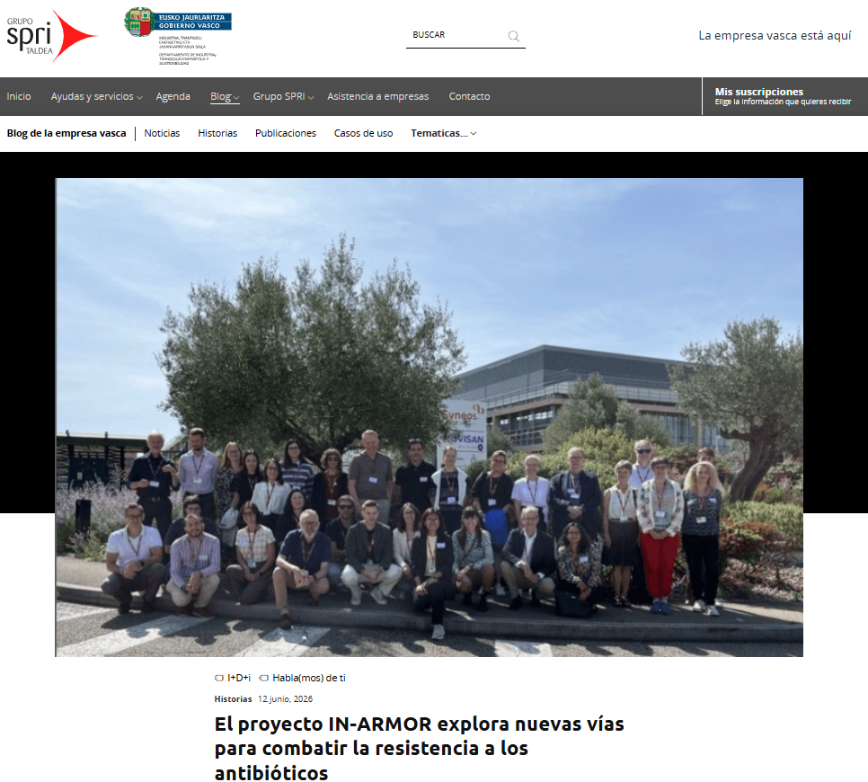
The IN-ARMOR project continues to gain visibility beyond the scientific community. On 12 June 2026, SPRI (Basque Agency for Business Development) published an article on its blog dedicated to I+D+i, highlighting IN-ARMOR as a European initiative exploring new ways to combat antimicrobial resistance.
The article describes how IN-ARMOR is investigating new therapeutic strategies based on strengthening the body’s own natural defences against drug-resistant infections, and singles out Biokeralty Research Institute as the Basque company participating in this Horizon Europe-funded initiative.
A different approach: boosting innate immunity
The SPRI article underlines the scale of the challenge IN-ARMOR is addressing: antimicrobial resistance occurs when pathogens evolve and antibiotics stop working, and without new solutions, resistant infections risk becoming one of the major health challenges of the coming decades.
Rather than developing new antibiotics, IN-ARMOR takes a complementary route, focusing on innate immunity, the body’s first line of defence. The project is investigating compounds capable of stimulating the immune system to produce its own natural antimicrobials and reinforce protective barriers against pathogens. To deliver these compounds effectively, the project is also developing advanced nanocapsules for the controlled transport and release of active substances, with an initial application targeting gastrointestinal infections.
Biokeralty’s role in the consortium
Within the IN-ARMOR consortium, Biokeralty leads activities related to exploitation of results, intellectual property and project communication, while also contributing its expertise in nanoparticle-based technologies and nanomedicine to the design and development of the nanocapsules.
Read the full article on the SPRI blog here.
Follow the future of the IN-ARMOR project and connect with its scientific community on its website and social media.